


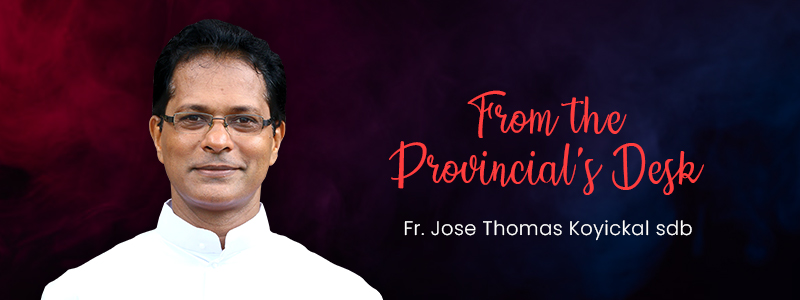
LIVING A SPIRITUAL LIFE IN INDIA TODAY: A SALESIAN PERSPECTIVE
Dear Confreres, we celebrate the Feast of St. Thomas, the Apostle of our beloved nation India, on 3 July and that of the first Indian saint St. Alphonsa on 28 July. Therefore, I thought it opportune to reflect with you on our role as Salesians, Christians and Indians in today’s world, especially in our beloved country, inspired by these two models of sanctity and apostolic fervour. India, we know is a land of ancient wisdom, vibrant cultures, varied faiths, profound religiosity and deep spirituality. Yet, it is also a land of contradictions and challenges. While celebrating the feast of St. Thomas and of St. Alphonsa, we are reminded of our identity as witnesses to Christ in a land marked by diversity and dynamism. In this context, drawing inspiration from St. Thomas and St. Alphonsa, we need to reflect and see how we can as consecrated persons be authentic witnesses and effective in our mission as evangelizers, especially of the young.
1. St. Thomas, Apostle of India and St. Alphonsa, the First Indian Saint
St. Thomas, known as the Twin, Apostle of Jesus Christ, is traditionally believed to be the first missionary to bring Christianity to India in 52 AD. Though many call him “doubting Thomas” for initially having questioned Christ’s resurrection, later he became an ardent Apostle and missionary. Having arrived at the Malabar Coast he seems to have converted many and established several Churches. His site of martyrdom at St Thomas Mount and the San Thome Basilica at Mylapore are a living testimony to his staunch faith. His journey to India was not just geographical – it was spiritual, courageous and transformative. He planted the seeds of faith that continue to bear fruit today. His courageous mission to preach the Gospel in a distant land from that of his origin is a stimulus that should spur us on in our missionary ardour.
St. Alphonsa Muttathupadathu was born on 19 August 1910 in Kudamalur, Kerala. She was the first woman of Indian origin to be canonized a saint by the Catholic Church. Baptised as Anna, she joined the Franciscan Clarist Congregation and took the name Alphonsa of the Immaculate Conception. Despite enduring lifelong illness and suffering, she radiated deep spiritual joy and unwavering faith. Her life we know is marked by humility, silent endurance and a profound love for Christ, which, though unknown at the time of her death in 1946 at the age of 35, inspires millions today.
I would like to call your attention to how St. Thomas and St. Alphonsa teach us the two dimensions of our Salesian spirituality: the active missionary zeal and the spirituality of daily life. St. Thomas is model of a courageous witness who proclaimed Christ in unfamiliar tongues and cultures. His martyrdom is a witness of total commitment to the Gospel. He challenges every one of us to go beyond our comfort zones and encounter Christ in the unfamiliar – be it a new culture, a marginalized group or the shifting values of modern youth. For Salesians, this means embracing a similar radical commitment to Christ (passion for Christ) – offering our time, energy, talents, and lives for the good of the young and the poor in India.
St. Alphonsa stands as a beacon of holiness deeply rooted in Indian culture and suffering. Her silent endurance and joyful spirit are examples of a spirituality that resonates with India’s own traditions of renunciation, inner peace and mystical union with the divine. Her life is an invitation to each of us to embrace a spirituality that is simple yet profound, joyful yet sacrificial.
St. Alphonsa teaches us that sanctity is possible in ordinary life, especially when lived with humility, love and perseverance.
2. Witnessing to Christ in India
Our first task as Christians, and more so as Salesians, is to be a witness to Christ – a visible sign of His love, joy and presence. In a country that is largely non-Christian, witnessing becomes a subtle yet powerful means of evangelization. It means being rooted in prayer, love for Christ and His Gospel, fidelity to our vocation and authenticity in relationships.
Living as a true witness to Christ today implies witnessing by our life, not merely by words. It involves embodying his teachings through actions, words and relationships. It means demonstrating love, compassion and forgiveness, while also sharing the gospel message and offering hope to those around us. This witness is not just a one-time event but a continuous journey of living out one’s faith in all aspects of life.
In a pluralistic society, our witness must be marked by respect, dialogue and authenticity. We are not here to impose, but to propose. It is to manifest the beauty of Christ through our joy, our service and our integrity. We are not called to be mere activists or social workers but missionary disciples. The Indian youth, especially in our context, seek authenticity. Our lives should proclaim Christ before our words ever do.
3. Evangelisation: The Salesian Way
Evangelisation is not a program, instead a way of life. It is the overflow of a heart in love with Jesus. Evangelisation must be incarnational. It implies that the second person of the Trinity took on human nature and became one of us in all things to save us. Thus evangelisation, in tune with the Salesian spirit, must become incarnational through accompanying the young, understanding their needs and leading them gently to encounter Christ. The places of our educative and pastoral presence, such as schools, hostels, parishes and youth centres, are places of encounter where the Gospel is not only preached but lived. Unless our evangelisation is incarnational it remains a notion.
At the same time, the process of evangelization must be contextual, sensitive to cultures, respectful of other faiths and grounded in dialogue. Don Bosco’s preventive system with its three pillars of reason, religion and lovingkindness are effective methods to realize our goals.
4. Commitment to the Poor
The poor are the privileged recipients of the Gospel. In India, with its vast socio-economic disparities, a Salesian’s commitment to the poor is a direct expression of Christ’s love. It must be noted here that poverty in India is not just economic but also structural, emotional, and educational. Our response must therefore be holistic and compassionate, not patronizing but empowering. India is a fast-developing nation and commitment to the poor can mean different in different settings. Whether through educational institutions, vocational training, street children centres or empowerment programs, we must ensure that our mission is always directed to the most deserving. We are called to be Good Samaritans, not just through charity, but through justice – challenging systems that oppress and walking with the marginalized. To walk with them is to walk with Christ Himself.
5. Culturally Rooted Spirituality
Our spirituality must be Indian in soul and Christian in essence. We can draw inspiration from the Upanishadic hunger for truth, the Gandhian call to simplicity and the Dalit cry for dignity. Silence, simplicity, respect for nature and hospitality are all values that resonate with Indian hearts. Salesian spirituality can draw from these local treasures, integrating them with the universal Christian faith and Salesian spirituality.
Inculturation makes the Gospel incarnate in Indian soil and makes our spiritual life more authentic and accessible. Today’s India poses many challenges: religious intolerance, growing secularism, consumerism, politicization of religion and pressures on minority institutions. Social inequities, casteism and gender discrimination have not disappeared fully from our ethos. As Salesians we must face these challenges courageously and prophetically without fear, compromise or aggression. Our strength lies in Christ and in our communities. Our institutions must remain sanctuaries of peace, dialogue, education and justice.
Being a Christian and Salesian in India also means being inter-religious: open to dialogue, appreciative of others and confident in our own identity. We must proclaim the Gospel not only with words, but with joy, service and integrity.
6. Universal Church, Local Roots
Our vision must go beyond borders while being rooted in our immediate context. The Gospel invites us to transcend narrow identities of caste, language, region or any particular group. As Salesians we must rise above divisions and create communities where all feel welcome. The Salesiancommunity is a witness to unity in diversity. The youth whom we serve needs to experience through us the global vision of the Church and the Congregation: one of fraternity, openness and shared mission.
We must not forget that we are part of a universal Church and an international congregation. Therefore, while we are deeply rooted in our cultures and customs, we should be conscious of the larger picture. Be it Christianity or Salesianity, in India they have been planted and nourished by many missionaries from different parts of the world. It is edifying that missionaries from India are working in many parts of the world today. Their commitment and hard work have been the seed bed for Christian and Salesian Spirituality in many places. We need to encourage this phenomenon, knowing that there is dire need for missionaries in different parts of the world. As a province we can be happy and rightfully proud that many from our province and place are working as missionaries in different mission lands. We have been involved much with the mission in Yemen and Nepal. We have been also sending confreres to other provinces as well in the recent past.
Here it is also important to know the value of intra-missionary movement – missionary work within India. Being a missionary means: availability, mobility, adaptability and courage. A Salesian must be willing to go where the need is greatest. In our context it is to be emphasised that availability means also willingness to move between the two states of our province and involvement in our common mission without reservation. Unless we are able to think beyond exclusivity and borders, how can we raise our voice against the political, religious and cultural polarization that India is facing at present? These are essential in order to speak with love, act with courage and stand firm in truth.
Likewise, our spirituality must not be individualistic. Community prayer, shared discernment, mutual support and fraternal correction are essential. Our young people must see in us models of communion, not isolation.
7. Salesians and the Youth of India
India has the largest youth population in the world. This is both a gift and aresponsibility. From climate change to digital addiction, from unemployment to gender violence – India’s youth face real challenges.
We must understand their context, their dreams, their doubts, their digital world. We should strive to lead them to prosperity – not just economic, but human and spiritual. We are called to help them become good citizens and saints, builders of a new India. We must form consciences, not just conduct rituals. Technology, social media, mental health issues, unemployment and moral relativism are affecting today’s youth. Many are spiritually disoriented and emotionally wounded. Our formation, methods and ministries must evolve to meet these challenges. Digital evangelization, psychological accompaniment, career guidance and family support are becoming more and more important in our pastoral approach. As Salesians we can be present in these realities. Through education, character formation, and faith development we accompany them in building a better future. They need mentors, not just managers. They require homes that welcome, schools that prepare, playgrounds that heal and churches that evoke their inner reality. Thus, we really become salt and light in today’s world.
Don Bosco’s pedagogy remains ever relevant: presence, dialogue, joy and trust are keys to winning the hearts of the young. We need to believe in their potential, even when they struggle to see it themselves.
With proper guidance, mentorship and opportunities the human potential in India, especially the youth, can be moulded to become global leaders, saints, innovators and change-makers. Salesian optimism believes in and fosters their potential.
8. With a Vision Towards Heaven
I wish to conclude my reflection emphasizing this all-important aspect of our mission. Our vocation as Salesians is primarily to equip our youth with a proper vision of their life. The mission we are engaged in is not just social or educational – it is spiritual. Our goal is heaven to which every soul created by God tends. Heaven is not a distant dream, but a present journey.
Being a Salesian in India today is a noble, demanding and deeply spiritual task. It requires courage, faith, creativity and love. As the youth of India are navigating a world of contradictions – tradition and modernity, hope and despair, spiritual hunger and consumer distractions – we try to understand them, listen, observe and journey with them patiently. We realize that what the young seek are belongingness, meaning, purpose and authenticity. More than just empty words, we impress them through relationships. We walk together with them as “pilgrims of hope”. When our lives reflect joy and hope, those walking with us are enthused. We become for them role models in moral integrity and faith in God. We become “a reason” for them to believe. Questions that we could ask ourselves are: Am I truly a Salesian? Am I rooted in God, committed to the young, joyful in community and generous in my mission? Am I open to learning, growing and being sent?
St. Thomas and St. Alphonsa serve as important models for us representing different facets of our faith’s history and spirituality. While St. Thomas embodies the enduring legacy of apostolic origins of the Church and commitment to spreading the Good News courageously, St. Alphonsa exemplifies the lived experience of faith and holiness in our personal life. They teach us how we can be both “Passionate for Jesus Christ” and at the same time “Dedicated to the Young”. May they help us to be ardent missionaries and committed religious.
Yours affectionately in Don Bosco,
Fr. Jose Koyickal sdb
Provincial
Province News
Recent Message
-
LENT: A JOUR...
23 March 2026 -
WORLD DAY OF...
23 March 2026 -
PREPARING FO...
01 December 2025 -
ON HUMAN DES...
21 November 2025 -
ST. CARLO AC...
21 October 2025 -
MISSION: THE...
21 September 2025 -
WITH MARY AS...
21 August 2025 -
LIVING A SPI...
02 July 2025 -
THE RESURREC...
29 April 2025 -
LENT: A JOUR...
29 March 2025
